For Chinese companies entering Southeast Asia through ODI, the key question is no longer just “Can the approval be obtained?”, but whether the project has a clear compliance pathway, efficient execution, and controlled long-term costs.
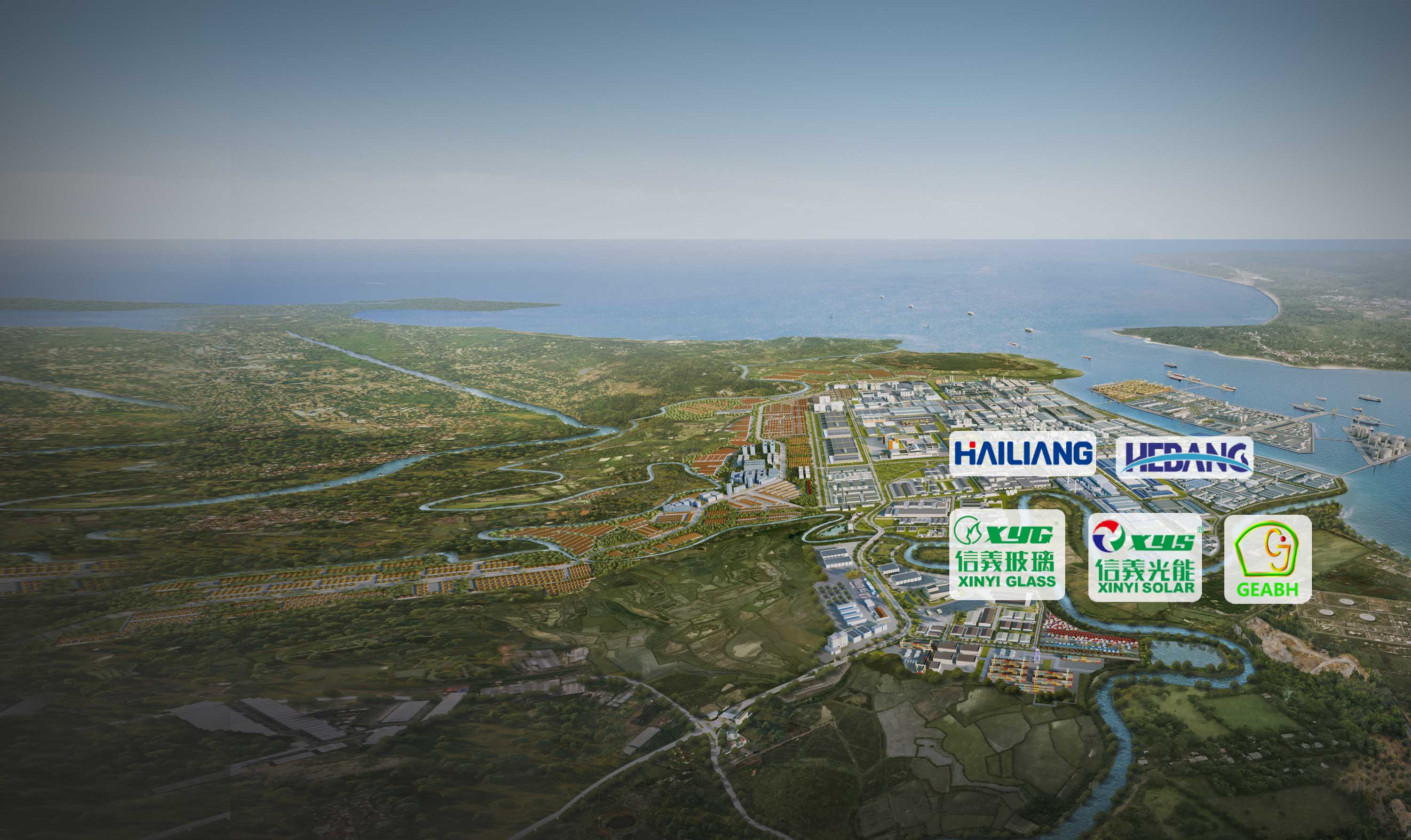
As a National Special Economic Zone (SEZ/KEK) in Indonesia, JIIPE integrates an industrial estate, deep-sea port, and industrial clusters to provide a highly reliable investment platform.
JIIPE is a National Special Economic Zone (SEZ/KEK) in Indonesia
Fully integrated industrial estate + seaport
Already home to multiple Chinese manufacturing companies
Why Now Is the Strategic Moment to Enter Indonesia
Indonesia is rapidly becoming a key destination for Chinese companies expanding into Southeast Asia. With global supply chain restructuring, manufacturing relocation, and growing regional demand, Indonesia offers strong advantages in resources, population, and policy support.
Chinese investment in Indonesia continues to grow across sectors such as metals, chemicals, new energy, and manufacturing. The Indonesian government is also streamlining processes through priority investment lists and the OSS licensing system.
For companies aiming to build overseas production capacity, optimize supply chains, or enter Southeast Asian markets, Indonesia is now a strategic destination.
Why ODI Projects Require the Right Location, Not Just the Right Country
In practice, ODI projects typically face three key challenges:
Can the project be executed legally and operationally?
Can construction and production start smoothly?
Are long-term operating costs competitive?
JIIPE’s core value addresses all three simultaneously:
SEZ policies reduce regulatory and tax uncertainty
Integrated industrial estate + port accelerates construction and logistics
Industrial clusters enhance supply chain efficiency
This means companies do not need to build their operational ecosystem from scratch.
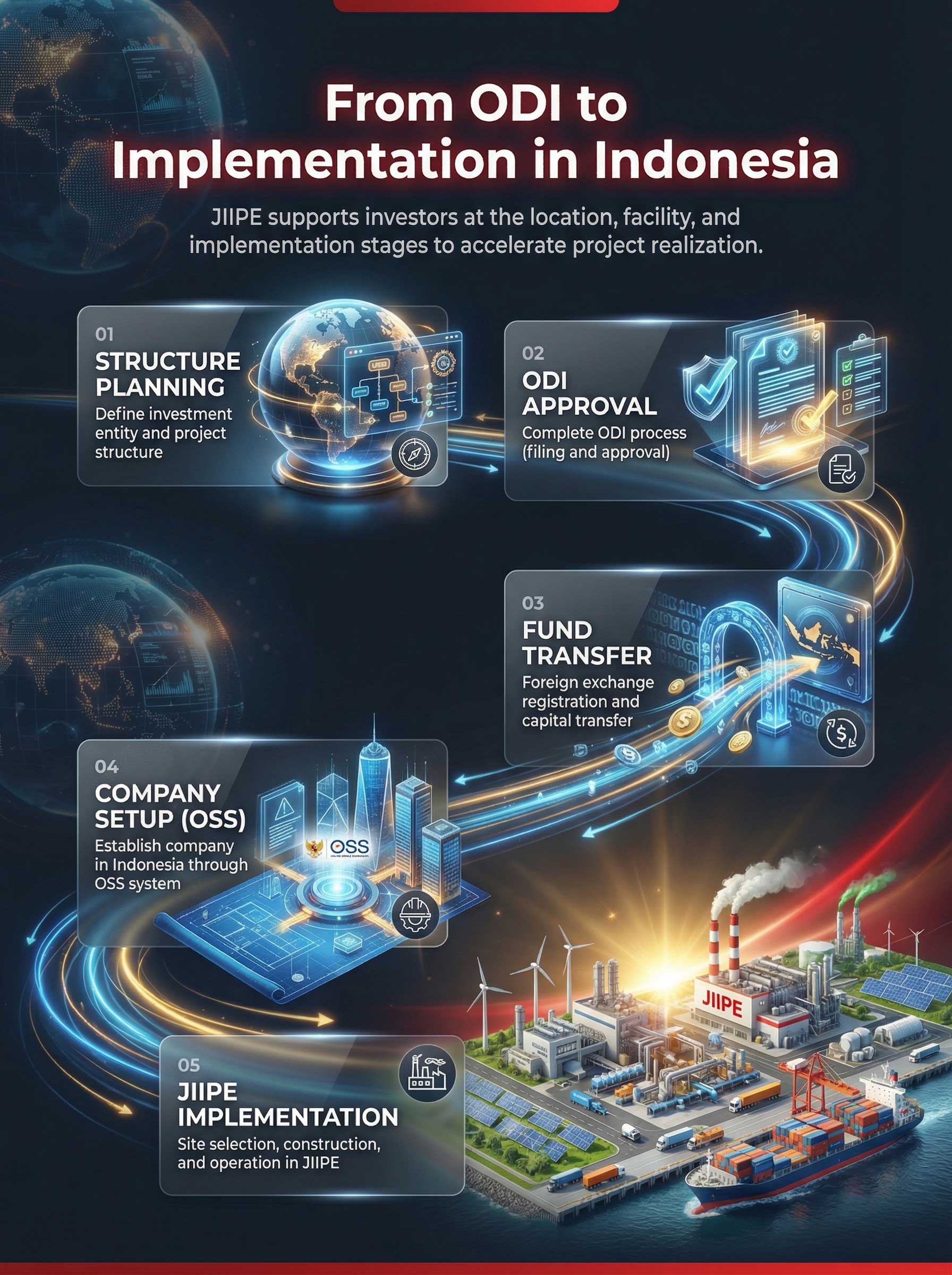
Your ODI Project: Filing or Approval?
Chinese companies investing overseas (ODI) generally go through:
NDRC (National Development and Reform Commission)
MOFCOM (Ministry of Commerce)
SAFE (State Administration of Foreign Exchange)
For non-sensitive countries and sectors, the process usually follows a filing system.
Key determining factors include:
Whether the project is a real investment
Whether it falls under sensitive sectors
Whether the investment structure is clear
Most manufacturing and industrial projects are categorized as non-sensitive.
How JIIPE Reduces Real Risks in ODI Projects
Point 1 — SEZ Advantage
Optimized tax and cost structure at a comprehensive level, not just partial incentives.
Point 2 — Integrated Estate & Port
Higher efficiency in export-import activities and lower logistics costs.
Point 3 — Industrial Clusters
Supports metals, chemicals, and new energy sectors through strong ecosystem synergy.
Point 4 — Alignment with Real Investment
Highly suitable for manufacturing projects, in line with ODI’s “real investment” principle.
What Type of Companies Are Best Suited for JIIPE?
Manufacturers targeting Southeast Asian markets
Export-import oriented processing industries
Metals, chemicals, and new energy sectors
Capital-intensive projects (factories / production bases)
Companies aiming to optimize long-term operational costs
FAQ
Q1: Are Chinese companies required to go through ODI to invest in Indonesia?
If establishing or controlling an overseas entity, it is generally classified as ODI.
Q2: Are projects in Indonesia considered sensitive sectors?
Most manufacturing projects are not classified as sensitive.
Q3: Can funds be transferred immediately after ODI filing?
No, foreign exchange registration (SAFE) is still required.
Q4: What is JIIPE’s key advantage?
The combination of SEZ status, integrated port, and industrial ecosystem.
Turn Your Investment into a Real Project in Indonesia